
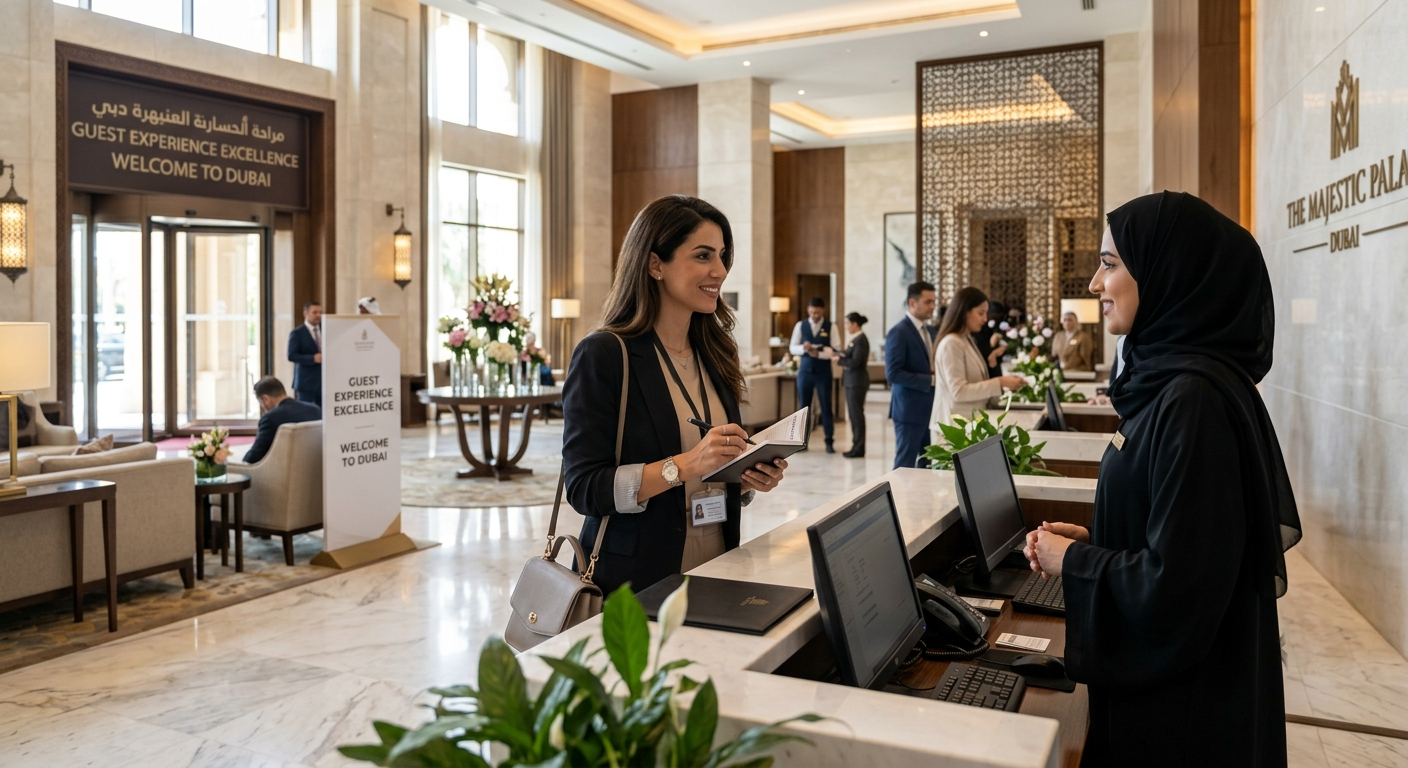
You have invested in staff training. You have documented your service standards. You have created SOPs for every touchpoint of the guest journey. But when your General Manager is not on the floor, when the busy Friday dinner service is in full swing, and when the new front desk associate is handling their first solo check-in — what is the guest actually experiencing?
This is the question that mystery shopping was designed to answer. And in the UAE hotel market, where guests’ expectations are among the highest in the world, the gap between your service standards on paper and your team’s actual performance in practice can make the difference between a five-star review and a damaging one.
This guide explains how professional mystery shopping programmes work, what they measure, how the data drives real service improvement, and why an increasing number of UAE hotel operators are making mystery shopping a regular part of their quality assurance strategy.
Mystery Shopping vs. Guest Satisfaction Surveys – What’s the Difference?
Hotel operators typically have access to two sources of guest feedback: formal satisfaction surveys (post-stay questionnaires, online reviews, brand survey platforms) and mystery shopping evaluations. These serve fundamentally different purposes and should not be treated as substitutes for each other.
What Guest Satisfaction Surveys Tell You
Satisfaction surveys capture how a guest felt about their experience. They are valuable for identifying broad sentiment trends, measuring net promoter scores, and tracking overall satisfaction over time. However, they have significant limitations for operational management:
- They rely on the guest’s memory, perception, and willingness to complete a survey — all of which introduce bias.
- They tell you the outcome (‘I was unhappy with the check-in’) but rarely the cause (‘the associate failed to make eye contact and did not offer to explain the room type’).
- Response rates are typically low — most guests who had a poor experience simply do not complete the survey. They leave a TripAdvisor review instead.
- They cannot assess service performance against your specific SOPs and brand standards.
What Mystery Shopping Tells You
Mystery shopping captures what your team actually does — measured against your defined service standards, regardless of whether the guest noticed or cared. This gives you something surveys cannot: specific, evidenced, actionable data about individual service touchpoints.
- It tells you exactly where in the guest journey your standards are being met — and where they are not.
- It provides scored, comparable data that can be tracked over time and across multiple properties.
- It gives your team leaders specific observations to use in coaching conversations.
- It holds your operation to account against the standards you have actually set — not the standards a guest retrospectively applies.
“Surveys tell you what guests think. Mystery shopping tells you what your team is doing. You need both — but for operational improvement, mystery shopping is the more actionable tool.”
— PROFIX Consulting Hospitality Practice, Dubai
What Does a Mystery Shopping Evaluation Actually Assess?
A well-designed hotel mystery shopping programme covers the full guest journey — from the moment a potential guest first contacts the property through to their post-checkout experience. Here is what a comprehensive evaluation typically covers:
Pre-Arrival Experience
- Reservation experience — phone manner, hold time, knowledge of room types, upsell attempts, accuracy of booking confirmation
- Email responsiveness — response time, tone, accuracy, and completeness of information provided
- Website experience — ease of booking, clarity of information, brand consistency
Arrival and Check-In
- Doorman / valet greeting — proactiveness, warmth, use of guest name
- Lobby welcome — eye contact, posture, immediate acknowledgement of arrival
- Check-in efficiency — wait time, accuracy, communication of hotel facilities and services
- Room orientation — whether the associate escorts or directs, and what information is shared
- Upselling and upgrade offers — delivery, training, and conversion quality
In-Room Experience
- Presentation standards — cleanliness, turndown quality, amenity placement
- Technology — functionality of TV, WiFi, and room controls
- Minibar and amenity accuracy — stocked per standard
- Response to in-room requests — speed, politeness, first-time resolution rate
Food and Beverage Service
- Restaurant welcome and seating — time to greeting, knowledge of reservations
- Menu knowledge — allergen awareness, ability to describe dishes, recommendation quality
- Service pace and attentiveness — checking back, clearing, anticipating needs
- Bill presentation and settlement — accuracy, timing, farewell quality
- Room service — order accuracy, delivery time, presentation standard, courteousness
Concierge and Ancillary Services
- Destination knowledge — ability to make informed recommendations for dining, activities, and transport
- Problem resolution — response when a request is made that requires creativity or follow-up
- Spa, gym, and pool — welcome, facility presentation, upselling of treatments
Checkout
- Proactive checkout enquiry — did the front desk anticipate checkout needs?
- Bill accuracy and explanation
- Departure experience — luggage assistance, transport arrangement, final farewell quality
- Loyalty programme handling — was the guest’s membership acknowledged and status actioned?
✨ The ‘Moment of Truth’ Concept in Hospitality Mystery Shopping
|
The Anatomy of a Professional Mystery Shopping Report
The value of a mystery shopping programme is entirely dependent on the quality of the evaluation framework and the report that follows. A tick-box score sheet is not enough. A professional report should include:
Quantitative Scores by Department and Touchpoint
Each touchpoint in the evaluation framework receives a numerical score against the defined standard. These scores aggregate into departmental scores and an overall property score — enabling direct comparison across reporting periods and, for multi-property groups, across properties.
Qualitative Narrative Observations
Behind every score is a specific observation. ‘The associate failed to make eye contact during the check-in process’ is actionable. ‘Customer service was average’ is not. Professional mystery shopping reports include a detailed written narrative for every evaluated area — giving your team leaders the specific, evidenced observations they need for meaningful coaching conversations.
Photographic Evidence Where Applicable
For physical standards — room presentation, F&B table settings, uniform compliance, signage — professional evaluators can document findings with photographs, providing irrefutable evidence of the standard at the time of the visit.
Benchmarking Against Brand or SOP Standards
Scores are not assessed in isolation — they are measured against the specific standards defined in your brand guidelines or SOPs. Where a brand standard has been adopted from a management company, we evaluate against that standard directly.
Trend Data Across Reporting Periods
A single mystery shop visit gives you a snapshot. A quarterly programme gives you a trend — showing whether the coaching and training interventions you have made between visits are producing measurable improvement.
How to Turn Mystery Shopping Data Into Real Service Improvement
The most common failure of hotel mystery shopping programmes is not in the evaluation — it is in what happens with the data afterwards. A report filed in a drawer changes nothing. Here is how to extract real operational value:
Share Results Transparently With Your Team
Mystery shopping is most effective when your team understands what it is, why it exists, and how the results are used. Surprise evaluations that lead to disciplinary action — with no context or development focus — create anxiety without improvement. Communicate the programme openly: ‘We use mystery shopping to understand the guest experience and to help each of you develop as hospitality professionals.’
Use the Data for Individual Coaching, Not Mass Communication
A departmental mystery shopping score is interesting. An individual observation — ‘the associate at position three did not offer a welcome drink during the check-in encounter at 3.45pm’ — is the foundation of a genuine coaching conversation. Train your managers to use mystery shopping observations in one-to-one development discussions, not in group announcements.
Identify Systemic Issues vs. Individual Performance Gaps
When the same issue appears across multiple touchpoints — for example, associates consistently failing to use the guest’s name — this is a systemic training gap, not an individual performance issue. Your mystery shopping data should be analysed to distinguish between these two categories, because they require different interventions.
Set Improvement Targets Between Visits
Each mystery shopping report should end with 2–3 specific, measurable improvement targets for the next visit. ‘Increase F&B service score from 68% to 75% by addressing the issues identified in menu knowledge and table clearing.’ These targets give your managers something to coach towards — and give the programme a clear purpose beyond observation.
Recognise Excellence Publicly
Mystery shopping catches problems — but it also captures excellence. When an evaluator observes an associate who went genuinely above and beyond, make sure that observation is shared with the team. Public recognition of excellent performance, driven by objective mystery shopping data, is one of the most powerful staff engagement tools available to hotel managers.
“Mystery shopping is not surveillance — it is a professional development tool that gives your team leaders the specific evidence they need to coach, recognise, and improve.”
— PROFIX Consulting Mystery Shopping Team, UAE
Mystery Shopping for Luxury Hotels in the UAE — What Changes?
The UAE is home to one of the most concentrated collections of luxury hotels anywhere in the world — and the standards expected in these environments demand a different calibre of mystery shopping evaluation.
Evaluator Selection
For a five-star or luxury hotel mystery shopping engagement, the evaluator must be genuinely comfortable in that environment. An evaluator who is visibly uncertain how to interact with a sommelier, unfamiliar with fine-dining etiquette, or uncomfortable in a high-end spa setting cannot make meaningful assessments of service quality at that level. Our luxury hotel mystery shoppers are selected specifically for their experience as genuine guests in premium environments — in the UAE and internationally.
Standards Assessment
Luxury hotel evaluation goes beyond procedural compliance. At this level, mystery shopping assesses the less tangible elements of service: anticipation (did the associate address a need before it was expressed?), personalisation (was the service tailored to this guest, or generic?), sincerity (did the interaction feel genuine, or scripted?), and refinement (was there elegance and ease to the service delivery?). These qualities require an evaluator with both the hospitality knowledge and the personal experience to assess them accurately.
Brand Standards and Management Company Requirements
International hotel management companies operating in the UAE — including those in the ACCOR, Hilton, IHG, and Marriott families — often have their own brand standards that properties are required to maintain. Our mystery shopping evaluations can be designed to directly assess compliance with these brand standards, providing ownership groups with independent assurance of operator performance.
🗓 How Often Should You Mystery Shop Your Hotel?
|
The ROI of a Mystery Shopping Programme
Hotel operators sometimes hesitate to invest in mystery shopping because the return is not immediately visible in a P&L line. Here is how to think about the commercial return:
Guest Retention
Research consistently shows that acquiring a new hotel guest costs between five and seven times more than retaining an existing one. A guest who has a genuinely excellent service experience — the kind that mystery shopping helps you build — becomes a repeat guest, a loyalty member, and a source of referrals. The financial value of a retained guest over a three-to-five-year period vastly exceeds the cost of a quarterly mystery shopping programme.
Online Reputation and Rate Premium
Online review scores directly influence booking conversion rates and the room rates guests are willing to pay. Hotels with TripAdvisor or Booking.com ratings above 9.0 command measurable rate premiums over competitors with lower scores. Mystery shopping drives the service consistency that produces high review scores consistently — not just on the days when management is on the floor.
Management Company Performance
For hotel owners, a mystery shopping programme provides independent evidence of whether the management company is delivering on the service standards committed to in the Hotel Management Agreement. When performance shortfalls are identified, ownership groups have objective, documented evidence to use in operator conversations.
Service Consistency Is a Management Choice
Great guest experience in a UAE hotel is not accidental. It is the product of clear standards, consistent training, objective measurement, and genuine coaching. Mystery shopping is the measurement tool that makes the rest of the system work — without objective feedback, standards drift, training becomes theoretical, and management teams lose visibility of what is actually happening at the guest touchpoint.
At PROFIX Consulting, our mystery shopping programmes are designed specifically for the UAE hospitality market. We deploy evaluators with genuine luxury hospitality experience, we build evaluation frameworks that reflect your actual brand standards, and we produce reports your management team can act on — not just file away.
Ready to See Your Hotel Through Your Guests’ Eyes?Book a free consultation with PROFIX Consulting to design a mystery shopping programme for your property. |